

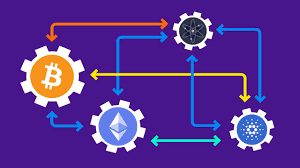

Cross-Chain Bridges and Interoperability The blockchain industry has evolved rapidly over the past decade. While early ecosystems operated in isolation, 2026 marks a major shift toward interoperability — the ability for different blockchains to communicate and share data seamlessly.
Cross-Chain Bridges and Interoperability
Cross-chain bridges are at the center of this transformation. As decentralized finance (DeFi), NFTs, gaming, and real-world assets expand across multiple networks, interoperability is no longer optional — it’s essential.Let’s explore how cross-chain bridges and interoperability trends are shaping the future of Web3.
What Are Cross-Chain Bridges?
Cross-chain bridges are protocols that enable the transfer of assets, tokens, or data between separate blockchain networks.
For example, a user may want to move assets from Ethereum to Solana or from Binance Smart Chain to Polygon. Without bridges, these ecosystems would remain isolated silos.
Bridges lock assets on the original chain and mint equivalent wrapped tokens on the destination chain. When users move assets back, the wrapped tokens are burned, and the original tokens are unlocked.
This simple concept has unlocked massive liquidity flows across the blockchain industry.
Why Interoperability Matters in 2026
In earlier crypto cycles, users often committed to a single blockchain ecosystem. Today, the reality is multi-chain.
Different blockchains offer distinct advantages:
- Ethereum for DeFi innovation
- Solana for high-speed transactions
- Polygon for low-cost scaling
- Binance Smart Chain for broad accessibility
Interoperability allows users and developers to leverage strengths across networks instead of being locked into one platform.
In 2026, cross-chain capability is becoming a baseline expectation for decentralized applications (dApps).
Major Interoperability Protocols Leading the Way
Several projects are driving interoperability innovation:
- Polkadot enables parachains to communicate within its ecosystem.
- Cosmos uses the Inter-Blockchain Communication (IBC) protocol to connect independent blockchains.
- Chainlink is expanding cross-chain messaging through its Cross-Chain Interoperability Protocol (CCIP).
These platforms focus not only on token transfers but also secure data transmission across chains.
Security Improvements in 2026
Cross-chain bridges have historically been targets for major exploits. Billions of dollars were lost in bridge hacks in previous years due to vulnerabilities in smart contracts and centralized validation systems.
In 2026, security has significantly improved through:
- Decentralized validator networks
- Zero-knowledge proofs (ZK proofs)
- Real-time transaction monitoring
- Multi-signature authentication systems
- Formal smart contract verification
Developers now prioritize “trust-minimized” bridge designs that reduce reliance on centralized custodians.
Security-first architecture has become a core requirement for user trust.
Rise of Cross-Chain DeFi
Interoperability is revolutionizing DeFi.
In 2026, users can:
- Borrow on one blockchain while providing collateral on another
- Access liquidity pools across multiple networks
- Earn yield in cross-chain farming strategies
- Swap assets seamlessly across ecosystems
Multi-chain decentralized exchanges (DEXs) are integrating cross-chain bridges directly into their interfaces, simplifying the user experience.
This reduces liquidity fragmentation and enhances capital efficiency across the entire crypto market.
Cross-Chain NFTs and Gaming
Blockchain gaming and NFTs are also benefiting from interoperability.
Players can now:
- Move NFTs between gaming ecosystems
- Transfer in-game assets across chains
- Trade collectibles on multiple marketplaces
Gaming projects are leveraging cross-chain bridges to expand user bases without forcing players to switch wallets or networks.
This trend is crucial for Web3 adoption beyond pure finance.
Enterprise and Institutional Adoption
Interoperability is no longer just a crypto-native concern. Enterprises exploring blockchain solutions require systems that integrate seamlessly with existing infrastructure.
Institutions need:
- Secure cross-chain data sharing
- Regulatory compliance features
- Scalable asset tokenization systems
Cross-chain solutions are helping connect private blockchains with public networks, enabling hybrid models suitable for enterprise environments.
As institutional participation grows, demand for reliable interoperability will increase further.
The Shift Toward Native Interoperability
While bridges remain essential, 2026 is also seeing a shift toward blockchains designed with interoperability at their core.
Instead of relying solely on external bridges, newer networks incorporate built-in communication layers that enable native cross-chain interactions.
This evolution reduces risk and simplifies user experience, potentially replacing older bridge architectures over time.
Challenges That Remain
Despite progress, interoperability still faces challenges:
- Complex user interfaces
- Gas fee variations across chains
- Regulatory uncertainties
- Ongoing security risks
Cross-chain transactions can sometimes confuse new users due to multiple confirmations and wallet interactions.
Improving user experience will be critical for mass adoption.
The Future of Interoperability
Looking ahead, cross-chain ecosystems may evolve toward:
- Universal blockchain messaging standards
- AI-optimized routing for asset transfers
- Cross-chain identity systems
- Fully composable multi-chain smart contracts
The ultimate goal is a seamless Web3 environment where users interact with decentralized applications without needing to know which blockchain they are using.
In that future, interoperability becomes invisible — and that’s when it truly succeeds.
Conclusion
Cross-chain bridges and interoperability trends in 2026 are reshaping the blockchain landscape. What once were isolated networks are now interconnected ecosystems enabling frictionless asset transfers, multi-chain DeFi strategies, NFT portability, and enterprise adoption.
Security improvements, decentralized validation models, and native interoperability protocols are making cross-chain infrastructure stronger and more reliable.
As Web3 continues to mature, interoperability will define its scalability and global adoption. The future of blockchain is not about one dominant chain — it’s about connected networks working together in a unified digital economy.


