

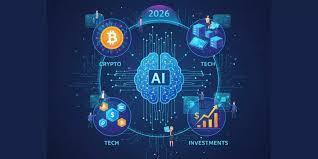

AI and Crypto in 2026 Artificial Intelligence (AI) and blockchain were once viewed as separate technological revolutions. AI focused on automation, machine learning, and data intelligence, while blockchain concentrated on decentralization and trustless transactions. In 2026, these two forces are converging — and the results are reshaping the entire crypto ecosystem.
AI and Crypto in 2026
From AI-powered trading to autonomous smart contracts and decentralized compute networks, the integration of AI and crypto is redefining how digital systems operate. Let’s explore how artificial intelligence is transforming blockchain infrastructure and why this convergence could define the next decade of innovation.
Why AI and Blockchain Are a Natural Fit
At first glance, AI and blockchain may seem different. AI thrives on data and optimization, while blockchain emphasizes transparency and immutability. But together, they solve each other’s weaknesses.
-
AI improves automation, efficiency, and predictive intelligence within blockchain systems.
-
Blockchain enhances trust, data integrity, and transparency for AI models.
This synergy creates a decentralized, intelligent ecosystem — where smart contracts can think, adapt, and respond dynamically.
1. AI-Powered Crypto Trading & Market Analysis
One of the earliest and most visible use cases of AI in crypto is algorithmic trading. AI models analyze:
-
Market sentiment
-
On-chain transaction data
-
Liquidity flows
-
Social media signals
Advanced AI systems now process vast datasets in real-time, identifying patterns human traders would miss.
In 2026, AI trading bots are no longer basic scripts — they’re machine-learning systems capable of adapting strategies dynamically. Institutional investors especially rely on AI-driven analytics to navigate volatile digital asset markets.
2. Smarter, Adaptive Smart Contracts
Traditional smart contracts on networks like Ethereum execute pre-written code exactly as programmed. They cannot adapt or learn.
With AI integration, a new generation of “intelligent contracts” is emerging. These systems can:
-
Adjust interest rates in DeFi protocols based on risk conditions
-
Optimize collateral requirements
-
Trigger dynamic responses to market volatility
By combining machine learning with blockchain logic, decentralized applications become far more efficient and responsive.
3. AI Enhancing DeFi Risk Management
Decentralized Finance (DeFi) protocols manage billions in total value locked. However, risk assessment has traditionally relied on static parameters.
AI changes that.
Machine learning models now evaluate:
-
Borrower behavior patterns
-
Market volatility
-
Liquidity stress indicators
-
Smart contract vulnerabilities
In 2026, AI-powered risk engines are helping DeFi platforms minimize liquidations and systemic risks. This shift is particularly important for attracting institutional capital.
4. Decentralized AI Networks
A major innovation in 2026 is decentralized AI marketplaces. Instead of relying on centralized tech giants for computing power, blockchain networks enable distributed AI processing.
Projects are building decentralized compute networks where:
-
Users provide GPU power
-
Developers access affordable AI resources
-
Data transactions occur transparently
This reduces dependence on centralized AI infrastructure and democratizes access to machine learning tools.
Blockchain ensures contributors are fairly compensated while maintaining auditability of model training and usage.
5. On-Chain Data + AI Insights
Blockchain provides one of the richest transparent datasets in finance. Every transaction, wallet interaction, and smart contract call is recorded publicly.
AI systems analyze on-chain data to:
-
Detect fraud
-
Identify whale accumulation
-
Monitor suspicious activity
-
Predict liquidity movements
Exchanges and compliance firms increasingly use AI to enhance blockchain analytics and regulatory monitoring.
6. AI in NFT & Digital Asset Creation
The NFT ecosystem has evolved beyond static images. AI-generated art, music, and digital collectibles are becoming mainstream.
In 2026, AI tools create dynamic NFTs that evolve based on:
-
Market conditions
-
Owner interactions
-
External data feeds
This introduces programmable creativity — where digital assets are no longer fixed but continuously transforming.
7. Security & Smart Contract Auditing
Security is one of the biggest concerns in blockchain. AI is now playing a crucial role in:
-
Automated smart contract auditing
-
Vulnerability detection
-
Exploit prediction
-
Network anomaly monitoring
Instead of manual reviews alone, AI systems scan codebases to identify potential weaknesses before deployment.
This significantly reduces the risk of hacks and protocol failures.
8. Autonomous Crypto Agents
One of the most futuristic developments in 2026 is the rise of AI-powered autonomous agents operating on blockchain.
These agents can:
-
Manage DeFi portfolios
-
Vote in DAOs
-
Execute yield strategies
-
Pay transaction fees
Essentially, they act as self-operating digital entities. Combined with blockchain identity systems, these agents could participate in decentralized economies independently.
Challenges of AI + Crypto Integration
Despite rapid innovation, challenges remain:
Data Privacy
AI requires large datasets, while blockchain transparency may conflict with privacy needs.
Computational Costs
Running AI models on-chain is expensive and resource-intensive.
Regulation
Governments are still defining how AI-powered financial systems should be governed.
Ethical Concerns
Autonomous systems managing financial assets raise accountability questions.
However, technological improvements and regulatory clarity are gradually addressing these issues.
The Bigger Picture: Intelligent Decentralization
AI and blockchain together represent more than a technological upgrade — they represent a new paradigm.
Blockchain provides decentralized trust.
AI provides decentralized intelligence.
In 2026, this combination is creating systems that are not only transparent and secure but also adaptive and predictive.
Final Thoughts
The convergence of AI and crypto in 2026 marks the beginning of intelligent decentralization. It’s no longer just about storing value or executing fixed smart contracts — it’s about building adaptive, data-driven, self-operating systems.


